

Millions of euros in penalties are paid each year in Europe for regulatory compliance failures, with sectors such as food and beverage, pharmaceuticals, and manufacturing accounting for a significant share. In fact, non-compliance to the new laws like EUDR can lead to fines reaching 4% of the EU turnover. That’s a lot, but not all! The impacts of failing to comply with regulations go beyond financial penalties. Organisations also risk reputational damage, supply chain disruptions, and lost business opportunities.
And yet, despite growing investments, regulatory compliance continues to be one of the most constant challenges for operational teams.
Part of the problem is that compliance itself has evolved. Today, organisations are managing increasingly complex global supply chains, navigating ever-changing ESG expectations, and responding to a steady stream of audits, RFIs, and stakeholder requests. As a result, what used to be a periodic task has become a continuous, data-heavy process.
In this blog, we’ll break down the top five reasons behind regulatory compliance failures and, more importantly, how to fix them in a way that is practical, scalable, and sustainable.
Key takeaways
- Regulatory compliance failures are often caused by systemic issues, not individual mistakes
- Fragmented data and manual processes are the biggest barriers to effective compliance
- A reactive approach increases the risk of failure to compliance
- Standardisation and supplier visibility are critical for audit readiness
- Modern regulatory compliance software enables proactive, scalable compliance
- Capturing knowledge within systems reduces dependency on individuals
What is regulatory compliance?
At its core, regulatory compliance refers to the ability of an organisation to adhere to laws, standards, and regulations relevant to its operations. However, in practice, it goes far beyond ticking boxes. It involves maintaining accurate documentation, ensuring traceability, and responding quickly to scrutiny from regulators and partners.
And in industries such as food, pharma, and manufacturing, this process extends into multiple layers of operations. It branches into maintaining product documentation and making sure each data is traceable and accessible when required, ensuring each step of internal documents (COAs, SOPs, etc.) complies with regulatory standards, ensuring supplier data is trackable and compliant, and many more.
In other words, regulatory compliance is not a single activity in heavily regulated industries like food and pharma. It is an ongoing system of processes, data, and accountability that ensures organisations operate safely, ethically, and transparently.
Why regulatory compliance is increasingly difficult today
Before diving into the root causes, it’s worth understanding why regulatory compliance has become more challenging in recent years.
Complex supply chains: Firstly, supply chains are no longer linear. Companies rely on multiple suppliers across regions, making it harder to maintain consistent standards and visibility.
Evolving regulatory requirements: Secondly, ESG and sustainability requirements have added new layers of reporting and accountability.
Increasing RFIs & questionnaires: Finally, the volume of audits and RFIs has increased significantly, putting pressure on already stretched teams.
As a result, many organisations find themselves in a constant state of firefighting, increasing the risk of failure to compliance.
Top 5 reasons behind regulatory compliance failures
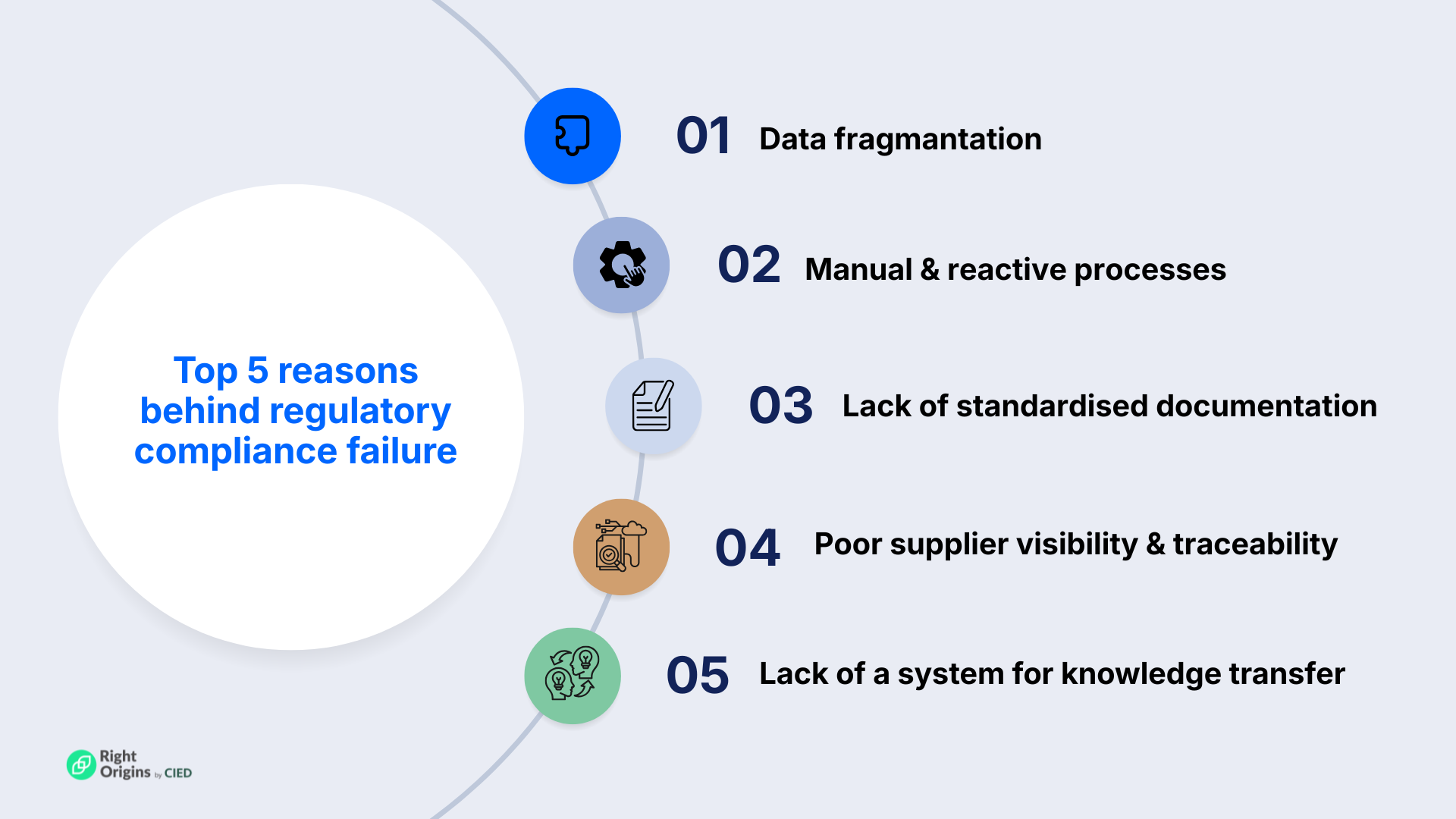
1. Fragmented data across systems
One of the most common reasons for regulatory compliance failure is fragmented data. Critical information is often scattered across emails, spreadsheets, shared drives, and disconnected tools. When an audit or compliance questionnaire arrives, teams scramble to gather data from multiple sources, leading to inconsistencies and delays.
This fragmentation not only slows responses but also increases the chance of errors, one of the key triggers of noncompliance.
How to fix it
The solution lies in creating a single source of truth for compliance-related data. Modern regulatory compliance software enables organisations to centralise documentation, making it easier to retrieve accurate information quickly. Tools like RightOrigins use AI to centralise your audit and compliance data and turn it into proof whenever required. Instead of searching across systems, teams can access everything in one place, reducing risk and improving efficiency.
2. Manual and reactive processes
Many organisations still rely on manual processes to manage regulatory compliance. Whether it’s responding to RFIs and regulatory questionnaires, updating documents, or tracking audit requirements, these tasks are often handled by people and in traditional ways. Teams wait until a request comes in before taking action, which leads to rushed responses and increased errors.
Over time, this reactive approach becomes unsustainable and contributes significantly to failure to compliance.
How to fix it
Adding compliance and audit preparation in everyday functions is one answer. Instead of trying to hold the fort when the storm hits, you can make compliance part of the process. A practical starting point is to identify repetitive tasks such as answering similar RFI and questionnaires or updating recurring documents, and streamline them through templates and workflows. Over time, this creates a system where compliance becomes part of day-to-day operations, rather than an interruption.
This is where regulatory compliance management software plays a critical role. By automating repetitive tasks and workflows, organisations can stay ahead of requirements rather than constantly catching up.
Platforms like RightOrigins, for instance, help teams structure and reuse compliance data, automate compliance questionnaire responses, COA validation, supplier data collection and multiple other manual workflows, making the compliance process faster and more consistent, without adding extra workload.
3. Lack of standardised documentation
Another major issue in regulatory compliance is the lack of standardisation. Different teams often use different formats, templates, and language when documenting compliance information. As a result, when data is required during audits, it becomes increasingly painful to find it and that leaves room for inconsistencies.
This inconsistency not only creates confusion but also raises red flags during audits, increasing the risk of failure to compliance.
How to fix it
Standardisation is key. Organisations need to establish clear templates, guidelines, and version control processes. Using regulatory compliance software, teams can ensure that everyone works from the same set of approved documents. This not only improves consistency but also creates trust with auditors and stakeholders.
4. Poor supplier visibility & traceability
In today’s interconnected supply chains, regulatory compliance depends heavily on supplier data. However, many organisations struggle to collect, validate, and maintain accurate information from their suppliers. Missing or outdated data creates gaps in compliance and increases exposure to risk.
This lack of visibility is a major contributor to failure to compliance, especially in industries with strict traceability requirements.
How to fix it
Improving supplier visibility requires structured data collection and continuous monitoring. Instead of requesting information ad hoc, define what data is required, how often it should be updated, and how it will be validated. Regular touchpoints with suppliers, rather than one-off requests, help ensure that information remains current.
Additionally, creating a system where supplier data is linked to internal compliance processes improves traceability. This makes it easier to respond to audits with confidence.
Furthermore, organisations can streamline supplier onboarding, automate data collection, and maintain up-to-date records through AI platforms like RightOrigins.
This ensures that compliance is not just internal but extends across the entire supply chain.
5. Knowledge locked in people, not systems
In many organisations, compliance knowledge resides with a handful of subject matter experts. While these individuals are invaluable, relying on them creates bottlenecks. When they are unavailable, or leave, the organisation struggles to maintain continuity.
This dependency increases the risk of failure to compliance and makes it difficult to scale operations.
How to fix it
The goal is not to replace expertise but to capture and distribute it. Start by documenting frequently used responses, key processes, and decision-making criteria. Build a shared repository that teams can access and contribute to. Encourage collaboration, so knowledge is validated and improved over time rather than remaining siloed.
You can also use platforms like RightOrigins that use purpose-built AI agents to help you digitise and structure your data and keep it always up-to date. This ensures everyone has the same data as it comes from one single source of truth, and information is not people-dependent.
AI systems and tools can help structure this knowledge, but the cultural shift of moving from individual ownership to collective intelligence is equally important.
The cost of compliance failure
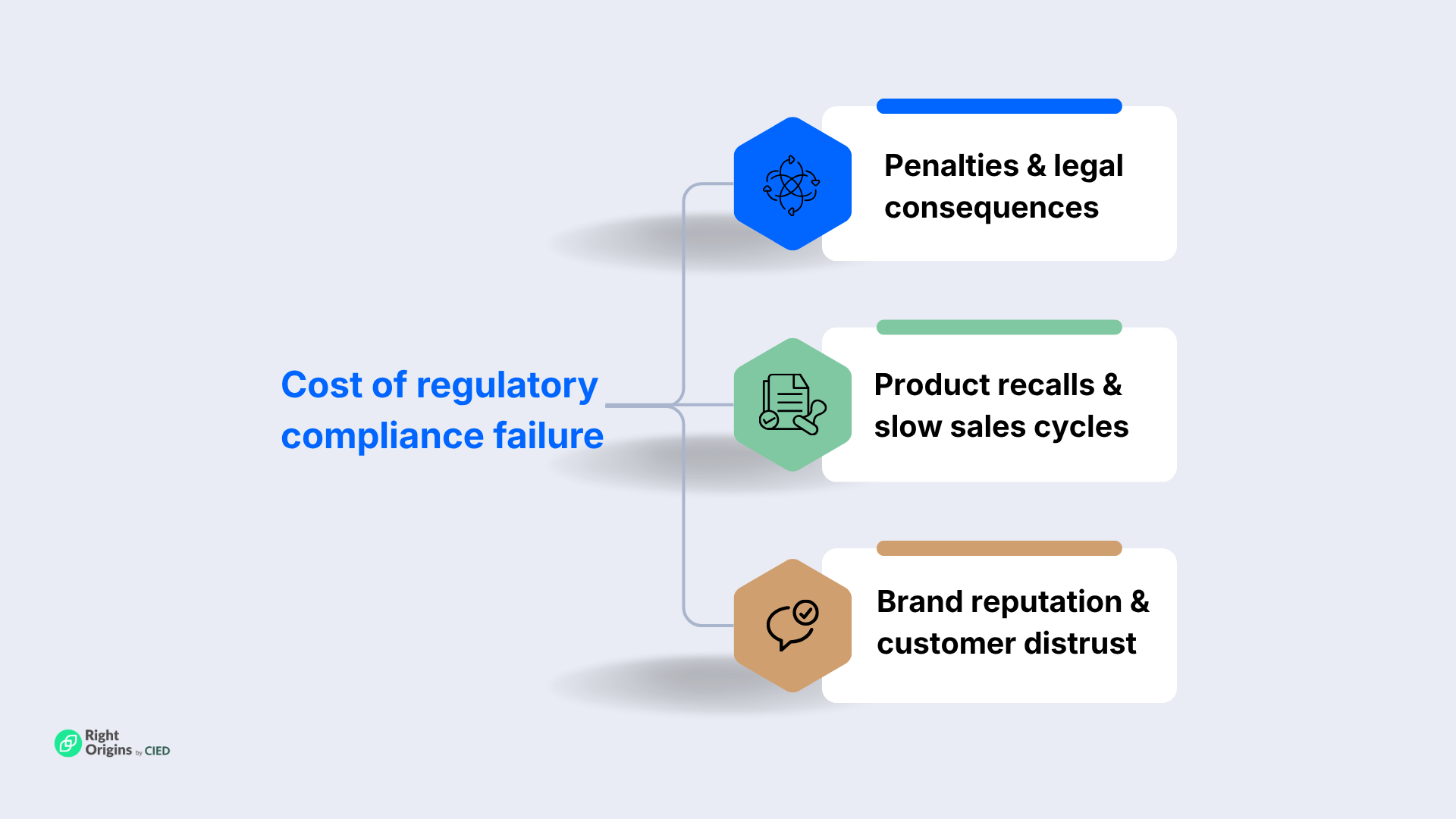
When people think about failure to compliance, they often focus on fines. But the real cost runs much deeper. There are visible costs like penalties, product recalls, and legal consequences. These are easy to quantify and often make headlines.
Then there are hidden costs, which are far more pervasive. Sales cycles slow down because compliance documentation isn’t ready. Supplier onboarding gets delayed due to missing information. Teams spend hours duplicating work instead of building on existing knowledge.
Over time, these inefficiencies compound. What starts as a minor gap in regulatory compliance can evolve into a systemic issue that affects operations, revenue, and brand reputation.
How modern teams are rethinking regulatory compliance
Forward-thinking organisations are reimagining regulatory compliance as a strategic capability rather than a burden. Instead of relying on traditional, manual processes, they are integrating evolving technologies and AI to make the most use of their data, automate workflows, and enable real-time visibility.
As a result, regulatory compliance is becoming faster, more accurate, and more scalable, allowing teams to focus on higher-value work.
Intelligent documentation: Modern teams are using AI to fundamentally change how compliance data is handled. What was once stored as static documents is now being transformed into structured, machine-readable information. This allows systems to interpret, connect, and reuse compliance data dynamically, reducing dependency on manual interpretation and making information far more actionable across workflows.
Less and less repetition: AI-driven regulatory compliance that removes repetitive work is becoming a norm. Instead of manually answering the RFI or audit questionnaires, collecting supplier data or finding compliance proofs repeatedly, leading organisation are using AI systems that learn automate the repetitive workflows. This doesn’t just save time, it standardises processes and significantly reduces inconsistencies that often lead to noncompliance.
Compliance is becoming predictive: Forward-thinking compliance teams are leveraging AI to analyse historical data, identify patterns, and flag potential risks before they escalate. This allows organisations to address issues proactively, rather than discovering them during audits or after a failure to compliance has already occurred.
Conclusion
Ultimately, regulatory compliance is way more than only meeting requirements. It’s about building systems that can adapt to complexity. The organisations that succeed are not the ones working harder, but the ones working smarter. By addressing the root causes of compliance failures and adopting the right tools and processes, businesses can stay on top of regulatory compliance and turn it into a competitive advantage. And in a world where scrutiny is only increasing, that shift is essential.
Frequently Asked Questions (FAQs)
What is regulatory compliance?
It is the process of ensuring that a business follows all relevant laws, regulations, and industry standards.
Why do companies struggle with regulatory compliance?
Companies struggle due to fragmented data, manual processes, lack of standardisation, and increasing regulatory complexity.
What is regulatory compliance software?
Regulatory compliance tools like RightOrigins help organisations manage, track, and automate compliance-related processes, ensuring accuracy and efficiency.
How does regulatory compliance management software help?
Regulatory compliance management software centralises data, automates workflows, and provides visibility across compliance activities, reducing risk.
What are the risks of failure to compliance?
Compliance failure can lead to financial penalties, reputational damage, operational disruptions, and loss of business opportunities.
How can companies improve their compliance processes?
By adopting structured systems, standardising documentation, and leveraging tools like RightOrigins to centralise and automate compliance workflows.