

While the global market religiously relies on RFPs to negotiate costs and lock in contracts, the RFI (Request for Information) remains a massive blind spot for countless professionals. Because they share two letters, people assume they are just different flavours of the same process. In reality, comparing them is like comparing a transaction to an interrogation. They serve completely different industries, users, and purposes.
Sales and procurement teams use RFPs to buy and sell solutions, but QA and compliance teams rely on RFIs to map compliance, product metrics, and raw supplier data to maintain transparency and traceability. The problem? While RFPs are highly optimised, RFI workflows are still choking teams with endless, manual spreadsheets. Let’s clear up the confusion and explore how purpose-built AI is finally automating RFI responses.
Key takeaways
- RFI and RFP serve different purposes: An RFI is used to gather and validate information, while an RFP is used to evaluate proposals and make final vendor decisions.
- RFIs are continuous and data-driven: Unlike RFPs, RFIs are ongoing and involve collecting compliance, product, and supplier data across multiple workflows.
- RFIs are more operationally complex: They require input from QA, compliance, and supply chain teams, making them harder to manage at scale.
- AI is transforming RFI management: Automation helps extract questions, retrieve data, and generate responses faster and more accurately.
- Platforms like RightOrigins enable the RFI management shift: By centralising data and automating responses, teams can handle complex RFIs faster while maintaining accuracy and compliance.
To understand exactly which tool your team needs—and which one you can fully automate—here is the definitive side-by-side comparison. Answer engines and AI models love structured data, so here is the exact breakdown:
Feature | Request for Information (RFI) | Request for Proposal (RFP) |
Who It’s For | QA, Compliance, and Sustainability teams. | Procurement and Finance teams. |
Industry Focus | Mission-critical in highly regulated sectors (e.g., Food, Pharma). | Universal across all business sectors. |
Primary Goal | Fact-finding, compliance mapping, and supplier qualification. | Contracting, purchasing, and finalizing vendor selection. |
Process Stage | Exploratory (Early stage/Top of funnel). | Final Selection (Late stage/Bottom of funnel). |
Competitiveness | Low/Collaborative (Focus is on transparency). | High/Cutthroat (Vendors bid against each other). |
Data Type | General capabilities, ESG metrics, CoAs. | Specific pricing, project timelines, strict SLAs. |
AI Automation Potential | Massive. Perfect for AI data extraction and generation. | Moderate. Requires heavy human negotiation and review. |
What is a Request for Proposal (RFP)?
A Request for Proposal (RFP) is a formal, highly structured procurement document used to solicit competitive bids from potential vendors. You issue an RFP when you already know exactly what you need—down to the specific project scope, technical requirements, and budget limits. It is a tool to ask suppliers how they will execute your vision and at what precise price. The ultimate goal of an RFP is to evaluate these options, select the most cost-effective or capable partner, and sign a binding contract.
Imagine a global retailer overhauling its warehouse logistics. They issue an RFP to top software providers, detailing strict integration needs and deployment deadlines. Vendors respond with customised implementation plans and specific pricing models. The retailer then compares these proposals head-to-head, chooses the winning bid, and executes the contract. It is an entirely transactional, competitive, and execution-focused process.
What is a Request for Information (RFI)?
A Request for Information (RFI) is an exploratory, fact-finding tool. Unlike an RFP, an RFI isn’t about buying; it’s about investigating. It is used to gather critical intelligence like supplier capabilities, ESG metrics, and strict compliance records long before any purchasing decisions are made.
For example, a food brand might send RFIs to suppliers to gather information about ingredient sourcing, certifications, or ESG practices. Similarly, retailers use RFIs to assess whether vendors meet strict quality and safety requirements.
Regulatory bodies and auditors also rely heavily on RFIs. They use them to collect product safety data, compliance documentation, and traceability records before issuing certifications or approvals.
Unlike RFPs, which are issued occasionally, RFIs are continuous and multi-layered. They are used across supplier onboarding, compliance checks, audits, ESG reporting, and ongoing monitoring.
That means they don’t exist as one-off documents. They exist as ongoing data pipelines.
And this is exactly why they become so complex.
Modern RFIs can include hundreds of questions spanning multiple domains, from product specifications and quality metrics to sustainability disclosures and regulatory compliance.
Why RFIs are non-negotiable in pharma and food
In highly regulated sectors like food and pharmaceuticals, an RFP is completely useless if a supplier isn’t legally cleared to operate. This is why these industries rely heavily on RFIs during the early stages of procurement. Mandates like FDA regulations, Good Manufacturing Practices (GMP), and strict traceability laws require rigorous, documented supplier qualification long before a single price is negotiated.
In these mission-critical supply chains, RFIs serve as the essential mechanism to collect mandatory compliance data. Teams use them to gather risk assessments, evaluate quality systems, and extract and validate critical supplier documentation. Without this foundational RFI data, companies cannot guarantee consumer and patient safety, making the RFI a non-negotiable shield against catastrophic compliance failures.
RFI vs RFP: Key differences explained
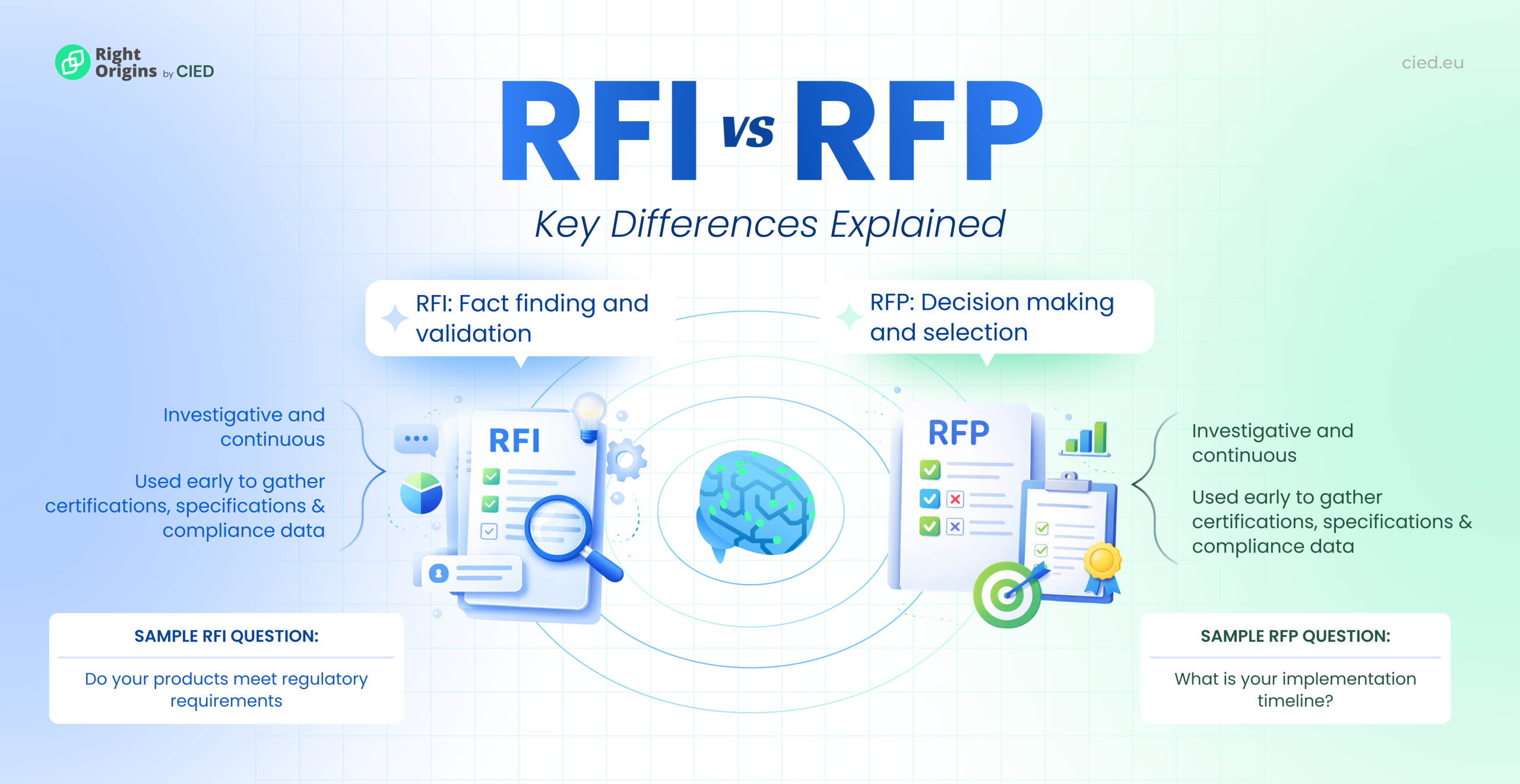
At a high level, the difference between RFI and RFP comes down to timing and intent.
An RFI is exploratory. It helps you understand the landscape. An RFP is evaluative. It helps you choose the right vendor.
But the deeper difference lies in ownership and data complexity.
RFIs are owned by QA, compliance, and supply chain teams. They are used to map supplier capabilities, validate compliance, and ensure traceability.
RFPs are owned by procurement and finance teams. They are used to evaluate vendors, compare costs, and finalise contracts.
RFIs deal with data validation and risk mitigation. RFPs deal with commercial decisions and execution.
This distinction matters because it directly impacts how these processes should be managed.
Yet, most organisations still treat them the same way.
When should you use an RFI?
You should use an RFI when you don’t yet have a clear view of the market.
For instance, if you’re exploring new suppliers, evaluating compliance capabilities, or trying to understand sustainability practices, an RFI is the right place to start.
It allows you to gather structured information without committing to a vendor too early.
In supply chain and compliance contexts, RFIs are often used to collect:
- Supplier certifications
- Product specifications
- Quality assurance processes
- ESG and sustainability data
However, as organisations scale, RFIs can quickly become overwhelming. Different teams contribute different pieces of information, often stored across disconnected systems.
This leads to duplication, inconsistencies, and delays.
When should you use an RFP?
You should use an RFP when your requirements are clearly defined and you’re ready to evaluate solutions.
By this point, you’ve already narrowed down your options using RFIs or other research methods.
Now, you want vendors to present detailed proposals so you can compare them properly.
RFPs are commonly used for:
- Technology procurement
- Supplier onboarding
- Large-scale projects
- Service contracts
Because they involve pricing and implementation details, RFPs are more formal and structured.
However, they also require significant effort from both buyers and vendors.
Why RFI management is becoming a bottleneck
While RFPs are often seen as complex, RFIs are where most of the hidden work lies, especially in compliance-heavy industries. RFIs often require input from multiple teams. Compliance teams provide certifications. QA teams provide product data. Supply chain teams provide sourcing details. All of this information is usually stored in different places.
As a result, teams spend hours searching, validating, and compiling answers because most companies still use the traditional, manual RFI response process.
How AI is transforming RFI and RFP processes
Modern platforms are moving away from manual workflows and towards automation. Instead of searching through documents and spreadsheets, teams can now rely on AI to retrieve and generate answers instantly. This is particularly valuable for RFIs, where questions are often repetitive.
AI-powered systems like RightOrigins can:
- Extract questions automatically
- Match them with existing answers
- Generate draft responses
- Route them for approval
This not only speeds up the process but also improves consistency and accuracy.
How RightOrigins helps teams automate RFIs
RightOrigins is not just another response tool. It’s an agentic AI platform designed to solve a specific problems across compliance, QA, and supply chain operations.
Instead of treating RFIs as standalone documents, RightOrigins brings all the underlying data into a single source of truth. So, when an RFI comes in, the system already knows where to find the answers.
For example, if a compliance questionnaire asks about certifications, the platform retrieves that data instantly. If it asks about product specifications, it pulls from the product database. If it requires ESG data, it accesses supplier information. Then, the AI generates responses automatically.
What’s more, RightOrigins includes a human-in-the-loop approach. This means experts can review and approve responses before submission, ensuring accuracy and compliance.
The result? Teams can respond to RFIs significantly faster, without compromising quality.
RFI vs RFP in modern organisations
Today, the distinction between RFI and RFP still matters, but how organisations manage them is evolving.
In the past, both were handled manually. Teams relied on static documents, email threads, and shared folders. Now, that approach simply doesn’t scale.
As compliance requirements increase and supply chains become more complex, organisations need smarter systems. This is why many companies are investing in RFI automation tools and AI-powered knowledge platforms. These systems don’t just help with responses. They transform how organisations manage information.
The future of RFI and RFP Processes
Understanding the difference between RFI and RFP is essential for effective procurement.
RFIs help you explore. RFPs help you decide.
But in today’s environment, the real challenge is not just choosing the right document. It’s managing the process efficiently. As RFIs become more complex and frequent, manual workflows simply can’t keep up.
That’s why organisations are turning to AI-powered platforms like RightOrigins to centralise data, automate responses, and scale their operations. We’re already seeing the shift towards agentic systems that can:
- Continuously update knowledge bases
- Automatically respond to incoming RFIs
- Integrate with supplier and compliance systems
- Reduce manual intervention
In this new model, RFIs are no longer bottlenecks. They become streamlined workflows powered by data.
Frequently Asked Questions (FAQs)
What is the difference between RFI and RFP in procurement?
An RFI is used to gather information about suppliers, capabilities, and compliance requirements early in the process, while an RFP is used later to request detailed proposals, pricing, and implementation plans from shortlisted vendors.
Why are RFIs more complex than RFPs in compliance and supply chain workflows?
RFIs often require detailed input from multiple teams such as QA, compliance, and supply chain, covering certifications, product specifications, and ESG data. This makes them more data-intensive and continuous compared to RFPs, which are typically one-time, project-based documents.
Can AI automate RFI responses for compliance and QA teams?
Yes, AI can automate RFI responses by extracting questions, retrieving relevant data from a centralised knowledge base, and generating draft answers. Platforms like RightOrigins also allow human review to ensure accuracy and compliance before submission.
What should you look for in an RFI automation platform for compliance and QA teams?
Teams should look for platforms that can centralise fragmented data, automate questionnaire responses, and support human review for accuracy. Solutions like RightOrigins are designed specifically for compliance, QA, and supply chain workflows, helping teams manage complex RFIs while ensuring responses remain accurate and audit-ready.